
Research & Innovation
Easing the burden of living with diabetes
12 November 2026
Student Austin Pek shares how continuous glucose monitoring has made managing his diabetes easier, and how subsidies have eased the financial burden.
“Am I able to handle this well both physically and financially?”
This was one of Austin Pek’s concerns as he came to terms with managing diabetes. Diagnosed with monogenic diabetes mellitus in 2023 at the age of 18, Austin had experienced rapid weight loss, frequent thirst and urination, tiredness and tingling pain.
“I found myself dozing off all the time despite having sufficient rest”, recalls Austin, who receives care at Singapore General Hospital (SGH). His symptoms made it difficult to concentrate on his studies. Despite eating more, he also had little energy for lion dancing, an activity he actively participates in.
Austin’s attending doctor, Dr Daphne Gardner, Senior Consultant in the Department of Endocrinology at SGH, explains that monogenic diabetes is a rare form of diabetes caused by a change in a single gene that affects how insulin is produced or used. Insulin is the hormone that helps glucose enter the body’s cells. In Austin’s case, the gene change affects insulin release, causing his glucose levels to rise markedly after meals. For some people, monogenic diabetes can affect them in much the same way as type 1 diabetes. Day to day, this may mean regularly checking their blood glucose and taking insulin injections.
Making glucose monitoring part of everyday life
Continuous glucose monitoring (CGM) has helped Austin better understand and manage his glucose levels. A CGM system uses a small sensor placed under the skin to measure glucose levels in the fluid surrounding cells. Readings are displayed on a compatible smartphone or reader, allowing users to track their glucose levels and trends throughout the day, rather than relying solely on individual finger-prick measurements.
For Austin, CGM has meant being able to check his glucose levels on his phone without repeatedly stopping for finger-prick checks, making it easier to balance studying, part-time work and lion dancing. “I can instantly take a look at my current blood glucose level just by lifting up my phone,” he shares. He also uses the readings to anticipate rising or falling glucose levels, reducing episodes of very high and low blood glucose, and to understand how different foods affect his glucose levels.
CGM has also supported decisions about his treatment. Dr Gardner explains: “Now, the use of CGM informs him about the appropriate insulin doses to use for his mealtimes.”
When Austin was initially treated with sulphonylurea tablets, CGM showed that his glucose levels remained outside the target range despite increasing doses of the medication. These readings helped inform discussions with his care team about switching to insulin injections for better glucose control.
His blood glucose levels are now better controlled with daily insulin injections, supported by carbohydrate counting and guidance from his care team on adjusting insulin doses when his glucose levels are above target.
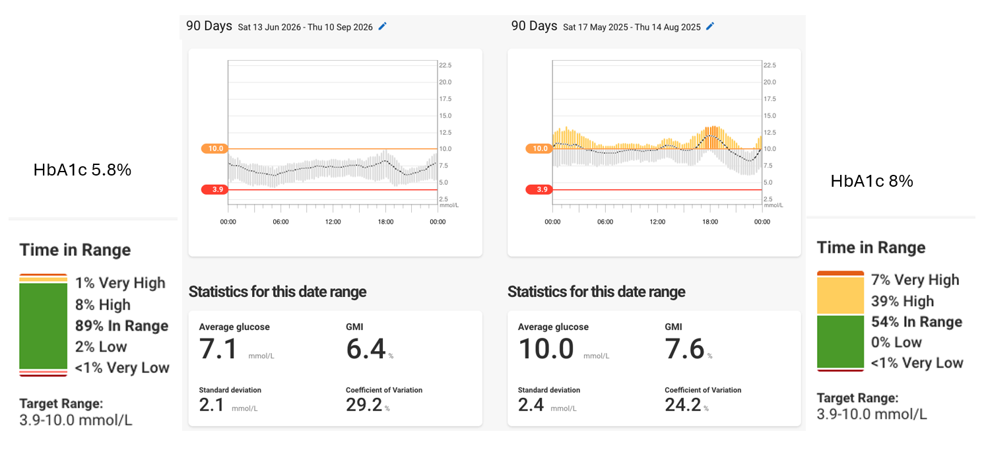
Austin’s glucose levels over 90 days while on insulin therapy (left) compared with his glucose levels while on oral sulphonylurea therapy (right).
Making ongoing care more affordable
Beyond managing his condition, Austin also faced the financial burden of ongoing diabetes care. While his parents cover his general medical bills, he previously spent about S$250 a month on diabetes supplies, including CGM consumables and insulin pen needles. This made it difficult to save money and sometimes left him worried about affording daily necessities, including food.
Relief came on 1 December 2025, when the government extended CGM subsidies beyond type 1 diabetes to include eligible children and adults with monogenic or pancreatogenic diabetes. The decision followed a health technology assessment by the Agency for Care Effectiveness (ACE) and a positive subsidy recommendation by the MOH Medical Technology Advisory Committee (MTAC), based on evidence of the clinical and cost-effectiveness of CGM for the treatment of monogenic and pancreatogenic diabetes mellitus. Eligible patients can receive means-tested subsidies for approved CGM systems at public healthcare institutions, with the level of subsidy depending on the care setting and their means-test results.
Following the subsidy implementation, Austin’s SGH care team and social worker reached out to discuss his eligibility. With government subsidy, the amount Austin pays for CGM treatment each month has fallen by about 60%. He now contributes a much smaller amount each month towards his diabetes supplies, while his parents cover the remaining cost of his subsidised CGM as part of his overall medical expenses.
“This allows me to save more money as well as spend on my other needs,” he shares. “I even have the ability now to donate and help others,” he adds. “All thanks to the aid I received.”
Living with a condition, and looking ahead
Although diabetes remains an ongoing part of his life, Austin says his condition is now generally under control. With better glucose management and reduced treatment costs, he feels more confident about managing his health and finances.
For others facing similar concerns, Austin offers a message of encouragement and a reminder that support is available: “Stay strong and happy. Don’t be scared especially when there are social workers there to support and help us.”