
When not to order chest X-ray ACG
Last updated 19 May 2026
ACE Clinical Guidelines (ACG) provide concise, evidence-based recommendations to inform specific areas of clinical practice and serve as a common starting point nationally for clinical decision-making.
Published on 24 May 2021
Last Updated on 24 May 2021
Overview
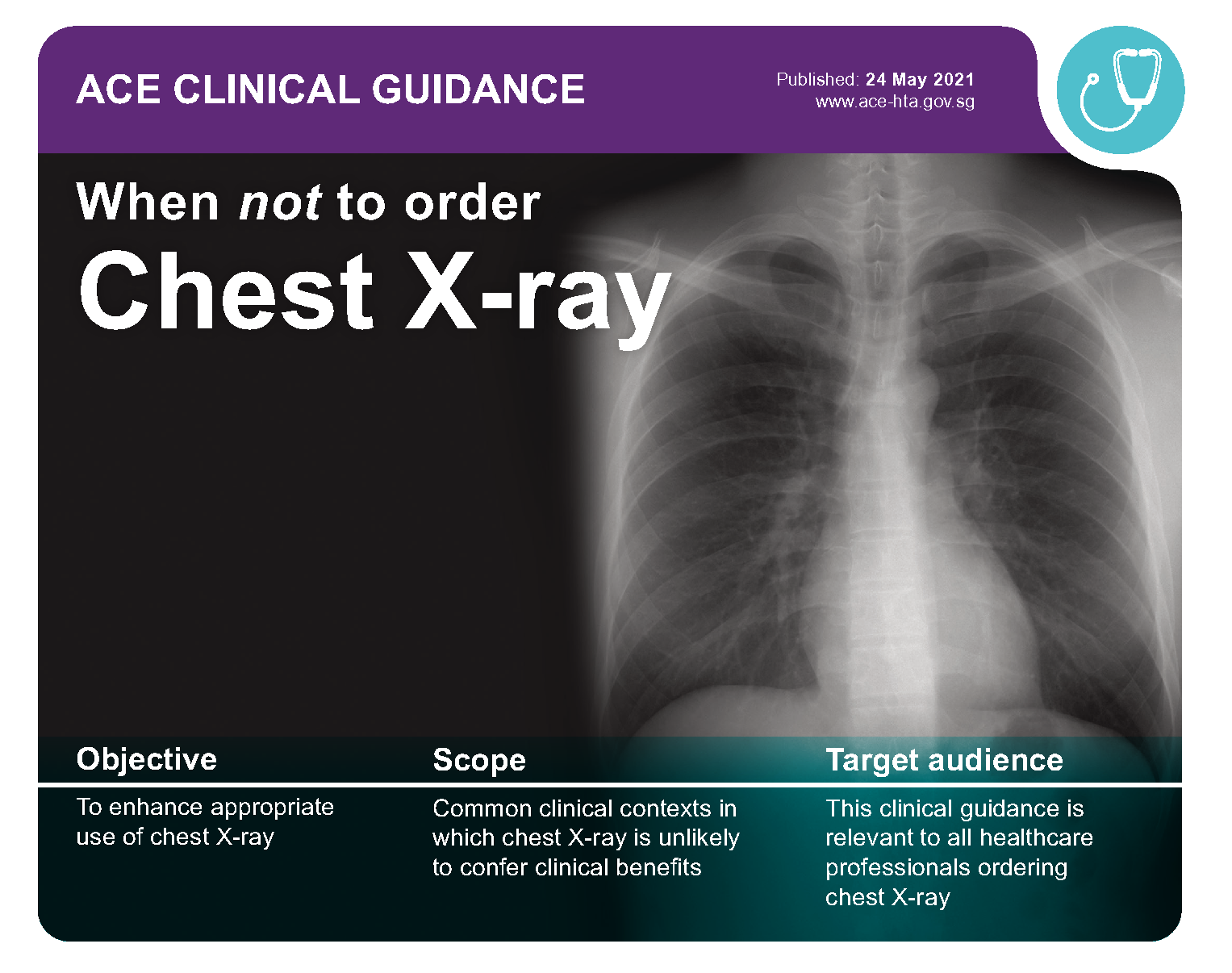
This ACE Clinical Guideline (ACG) outlines some common clinical contexts in which chest X-ray (CXR) is unlikely to confer clinical benefits. Examples of targeted use of CXR in these clinical contexts are included where applicable.
ACGs serve as the primary reference for clinical management in Singapore's healthcare system and can inform the standard of care (i.e. the treatment and level of care that is considered reasonable and appropriate by medical experts in respect of a given condition). Our guidelines, developed through rigorous evidence review and multi-disciplinary expert group inputs, may inform healthcare policy decisions and funding frameworks, and may have other system-wide implications.
ACG recommendations
General medical examination: CXR may not be indicated.
Preoperative testing: CXR may not be indicated.
Lung cancer screening: CXR is not indicated.
Download the ACG
When not to order chest X-ray (May 2021) [PDF, 1 MB]
Request for a hardcopy
Registered doctors, pharmacists and nurses may claim 1 Continuing Medical Education (CME)/Continuing Professional Education (CPE) point under category 3A/ category V-B for reading each ACG.
Statement of Intent
This ACE Clinical Guidance (ACG) provides concise, evidence-based recommendations and serves as a common starting point nationally for clinical decision-making. It is underpinned by a wide array of considerations contextualised to Singapore, based on best available evidence at the time of development. The ACG is not exhaustive of the subject matter and does not replace clinical judgement. The recommendations in the ACG are not mandatory, and the responsibility for making decisions appropriate to the circumstances of the individual patient remains at all times with the healthcare professional.
Introduction
Chest X-ray (CXR) is one of the most common imaging tests performed in clinical practice worldwide, including in Singapore. Its widespread use across various settings encompasses diverse indications. However, for most individuals with neither symptoms nor significant findings from history and physical examination suggesting that CXR may be required, current evidence shows that the test does not confer clinical benefits.
Clinical utility of CXR
The decision regarding whether to order CXR, like any clinical decision-making, involves weighing the expected benefits against the potential risks. The potential risks with CXR include adverse effects of radiation exposure and morbidity arising from investigation or management of incidental findings.1-4
CXR is typically not indicated for individuals with neither symptoms nor significant findings from history and physical examination suggesting a clinical need for it. In such instances, CXR is generally of low yield, not adding meaningful information to reliable history and physical examination.1 Conversely, CXR can be a helpful test when used in a targeted manner in response to an identified clinical need.
This clinical guidance outlines some common clinical contexts in which CXR is unlikely to confer clinical benefits.
CXR for general medical examination
Recommendation 1: General medical examination: CXR may not be indicated
CXR is common as part of general medical examination, including for employment and admission into higher learning institutions.1-3 Historically, the main reason for CXR in general medical examination has been to screen for possible underlying pathology, particularly active pulmonary tuberculosis (TB).1
Current evidence points to CXR contributing little to detection of new TB cases in the absence of risk factors for or symptoms of active pulmonary TB.5-7 In line with this evidence, the World Health Organization (WHO) recommends targeted screening for active pulmonary TB, namely in individuals at higher risk of active pulmonary TB (such as those with human immunodeficiency virus (HIV) or close contacts of TB cases).8
Other examples of targeted use of CXR as part of general medical examination in Singapore may include:
Individuals undergoing pre-employment or pre-enrolment medical examination for certain jobs or courses, including those involving interaction with vulnerable populations (such as healthcare or early childhood education)
Individuals employed for particular vocations (such as commercial divers or those with occupational exposure to respiratory hazards)
Foreigners applying for work pass, dependent pass, student pass, or long-term visit pass9
Notepad: Note on general medical examination in Singapore Individuals should be advised to check and adhere to prevailing medical examination requirements stipulated by the employer, admitting higher learning institution, or other relevant agencies (for example, Ministry of Manpower or Ministry of Education). |
CXR for preoperative testing
Recommendation 2: Preoperative testing: CXR may not be indicated
When there are no symptoms and no significant findings from history and physical examination suggesting that CXR may be required, CXR findings usually do not alter the management decision or clinical outcomes.1,10
CXR would still be useful for specific clinical presentations, with some examples below of targeted use of CXR for preoperative assessment:
Chest-related surgery
Suspicion of acute or potentially unstable chronic cardiopulmonary disease
Elderly patients (especially those aged 70 years and older)
Increased patient-related or procedure-related risk (such as history of cardiopulmonary disease, unreliable history or physical examination, high-risk surgery)
CXR for lung cancer screening
Recommendation 3: Lung cancer screening: CXR is not indicated
Lung cancer screening is aimed at detecting lung cancer in individuals at higher risk of the disease before symptom onset. Not having adequate sensitivity or specificity as a lung cancer screening test,11 CXR has not been found to be beneficial in lung cancer screening.12,13 Low-dose computed tomography (CT) is the imaging modality and test of choice to screen for lung cancer in individuals at higher risk of the disease.14
Expert group
Chairperson
Clin Asst Prof Gan Wee Hoe, Occupational Medicine (SGH)
Members
Adj A/Prof Gregory Kaw Jon Leng, Diagnostic Radiology (TTSH)
Asst Prof Adrian Kee, Respiratory Medicine (NUH)
Clin A/Prof Phua Ghee Chee, Respiratory Medicine (SGH)
Adj A/Prof Edwin Seet Chuen Ping, Anaesthesiology (KTPH)
Clin Asst Prof Gilbert Tan Choon Seng, Family Medicine (SHP)
Clin A/Prof Tan Swee Yaw, Cardiology (NHCS)
Project lead
Adj A/Prof Tan Cher Heng, Diagnostic Radiology (TTSH)

Feedback
Click here to give us feedback on this ACG.
Related ACGs
© Agency for Care Effectiveness, Ministry of Health, Republic of Singapore
All rights reserved. Reproduction of this publication in whole or in part in any material form is prohibited without the prior written permission of the copyright holder. Application to reproduce any part of this publication should be addressed to: ACE_HTA@moh.gov.sg
Suggested citation:
Agency for Care Effectiveness (ACE). When not to order chest X-ray. ACE Clinical Guidance (ACG), Ministry of Health, Singapore. 2021. Available from: go.gov.sg/acg-when-not-to-order-chest-x-ray
The Ministry of Health, Singapore disclaims any and all liability to any party for any direct, indirect, implied, punitive or other consequential damages arising directly or indirectly from any use of this ACG, which is provided as is, without warranties.